Jamil Hasan – Turning Crypto Lessons Into a Record
Visionary Crypto & Blockchain Thought Leader of the Year 2026

Jamil Hasan | Founder, Author & Podcast Host | Crypto Hipster Publications LLC
Jamil Hasan did not arrive in cryptocurrency as an outsider looking for a quick opportunity. He came to it after years spent inside the machinery of traditional finance, including a long stretch at AIG, where he learned how risk frameworks, regulation and institutional decision-making actually work in practice. That grounding shaped the way he looked at Bitcoin and blockchain technology when he first encountered them in 2017. He was not drawn in simply because a new asset class had appeared. He was drawn in because he saw the possibility of building financial systems differently, and he wanted to understand whether that possibility could hold up under pressure.
EliteX proudly features Jamil Hasan in this edition, recognizing a distinguished journey of leadership, innovation, and meaningful impact.
What followed was not a comfortable education. Hasan lived through multiple market cycles from the inside. He made money and lost money. He backed platforms that later failed and encountered people who did not deserve his trust. He watched technologies that looked unstoppable collide with poor governance, excessive leverage and plain human error. Rather than souring him on the industry, those experiences redirected his attention. He stopped asking what a given token might be worth and started asking a more durable question: what are people actually building, why are they building it, and what makes these systems succeed or fail.
Blockchain succeeds when we no longer need to mention it.
That shift in focus became the foundation of his work as host of the Crypto Hipster Podcast. Over hundreds of conversations with founders, engineers, investors and researchers from around the world, Hasan built a wide view of an industry that resists easy summary. He came to see crypto not as one movement heading in a single direction, but as hundreds of competing ideas about what should be centralized, who should hold power, where trust belongs and what kind of systems are worth building at all. The people behind those ideas, he noticed, bring more than technical skill to the table. They bring ambition, fear, ego, conviction and very different definitions of progress, and those human qualities shape outcomes as much as the code does.
That belief runs through his book, Inheriting Saturn. Hasan did not want to write another volume that explains cryptocurrency in the abstract or forecasts where Bitcoin might trade next. He wanted to preserve something harder to capture: what builders believe, what they have learned and what responsibility comes with creating something that might outlive them. Much of the book grew directly out of his podcast conversations, and it is structured around four acts named Mercury, Earth, Jupiter and Saturn, tracing a path from early experimentation toward the harder questions of stewardship that come later.
Those questions come into sharp focus in the book’s Jupiter section, where Hasan places Charlie Lee, the creator of Litecoin, even though he did not interview him directly for the project. Lee made the striking decision to sell or donate his Litecoin holdings while continuing to support the project, and Hasan finds the question behind that decision more interesting than the decision itself. Most founders are celebrated for how much of what they build they manage to keep. Lee’s story lets Hasan ask nearly the opposite question: what does it mean when a founder lets go, and can reducing a personal financial stake actually protect a project’s credibility rather than undermine it. Alongside Lee, Hasan places David Schwartz of the Litecoin Foundation, whom he did interview, to examine what happens after a founder steps back and someone else has to carry a mission forward.
Hasan then places a name that, at first glance, seems to belong to a different world entirely: Maurice Hank Greenberg, the longtime leader of AIG, the institution where Hasan spent years of his own career. Greenberg’s presence in the book lets Hasan take the question of stewardship outside blockchain altogether. Titles, assets and authority can be transferred on paper, he argues, but judgment, institutional memory and an understanding of why something was built a certain way cannot be handed over nearly as easily. He even recounts a brief, almost wordless encounter with Greenberg in a New York office lobby years earlier, an exchange that later struck him as a small, fitting illustration of how influence can remain embedded in an institution long after the person who built it has moved on.
Inheriting Saturn reaches beyond executives and protocol founders as well. Hasan deliberately includes artists and creators, among them Bran Symondson and Arabella Proffer, because he believes crypto did not only reshape financial instruments. It also unsettled long-held ideas about art, ownership, provenance and what it means to create something in a digital world. For Hasan, an industry cannot be understood only through the people writing its code, and the artists in the book offer a view of that transformation from a different vantage point entirely.

Founders may have to give something up for their work to survive.
Hasan is candid about the industry’s unresolved problems, and he sees most of them as human and institutional rather than purely technical. Trust sits at the center. Crypto was built partly on the idea that people should not need to place blind faith in centralized intermediaries, yet the industry has repeatedly recreated the very problems it set out to challenge, through centralized failures, weak governance, security breaches and situations where users believed they were dealing with decentralized systems while control remained concentrated in a few hands. He has felt some of those failures directly, and he says that losing money because a system collapsed changes the way a person thinks about the word trust far more than any theoretical discussion of decentralization ever could.
Decentralization, in his view, does not remove the need for governance. It complicates it. Someone still sets the rules, someone still writes or changes the code and someone still decides how resources get allocated. Usability remains an enormous hurdle too. Seed phrases, wallets, bridges, gas fees and irreversible transactions may feel routine to people who have spent years in the industry, but they intimidate newcomers, and Hasan believes the experience needs to become dramatically simpler if blockchain is ever going to reach billions of people. Security has to keep pace with that simplicity, since a system where a single mistake can permanently wipe out someone’s savings is not yet a workable consumer experience. Regulation adds another layer of difficulty, since the industry needs enough clarity for legitimate businesses to operate and for consumers to have real protection, without rules so rigid that only the largest institutions can afford to participate.
Looking toward the years ahead, Hasan expects the industry to keep moving from proving that it exists toward proving that it is useful. He points to several trends that matter less individually than they do together, including tokenization, stablecoins and blockchain-based payments, interoperability between networks, privacy-preserving verification and the growing intersection between blockchain and artificial intelligence. He is quick to note that none of these technologies should be judged by technical sophistication alone. The real test, he says, is what they change for actual people: whether tokenization broadens access rather than simply creating another asset to trade, whether stablecoins make financial systems more reachable, and whether blockchain can help establish trust in a world increasingly shaped by machines making decisions and transacting with one another.
Hasan increasingly describes his own role as one of translation rather than promotion. He is not trying to convince people that they need to own cryptocurrency, and he does not think adoption should start with a recommendation to buy something. Instead, his work is about helping people understand what is being built, who is building it, where the risks sit and what questions are worth asking. On the podcast, he often begins conversations not with a protocol or a token but with a simple question about what problem the founder was actually trying to solve, a starting point that tends to lead somewhere far more revealing than a technical walkthrough. He carries the same instinct into Inheriting Saturn, presenting readers with people who often disagree with one another rather than flattening the industry into a single point of view, because he believes understanding an industry means developing the judgment to evaluate competing ideas rather than memorizing a narrative.
For organizations weighing whether to adopt blockchain, Hasan offers a simple starting point: begin with the problem you are trying to solve, not with the technology itself. If blockchain genuinely improves the answer, it is worth exploring. If it does not, there is no reason to force it into the solution. He applies a similar standard to transparency, security and efficiency more broadly. Putting information on a blockchain does not automatically make it accurate, and a secure protocol can still exist inside an insecure ecosystem if bridges fail or private keys are stolen. He thinks about security as a property of an entire system rather than a single feature, and he is comfortable saying that sometimes a traditional database is perfectly adequate for the job at hand.
To entrepreneurs and young professionals hoping to build a career in the space, Hasan’s advice centers on patience and humility. He urges people to learn the difference between being early and being right, noting that a rising market can make almost anyone look intelligent for a while without requiring any real judgment. He encourages newcomers to study the history behind Bitcoin and earlier attempts at digital money, to talk directly with people who are building rather than only with those who already share their conclusions, and to become comfortable saying they do not know something, given how many disciplines blockchain now touches. He also advises separating personal identity from token prices, building skills that hold their value through a bear market, and treating failure as a source of lessons rather than something to romanticize. Founders in particular, he says, should think early about stewardship and ask not only how to build something but what happens to it without them, a question he traces directly back to Charlie Lee’s story.

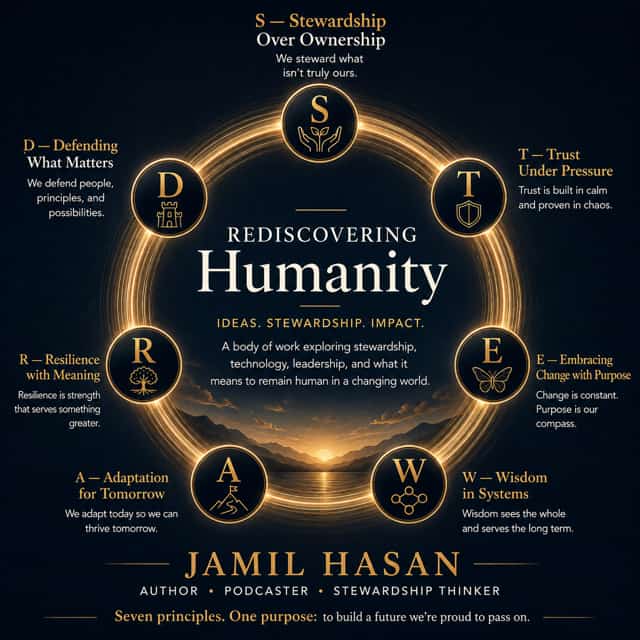
Looking ahead, Hasan’s own vision for crypto has become less about cryptocurrency itself than it was when he entered the industry in 2017, a shift he considers a sign of the industry maturing rather than losing relevance. He believes blockchain will have succeeded when people stop needing to be told that a product uses it at all, in the same way that most people no longer think about the internet protocols running underneath an email or a video call. He expects governance and stewardship to become as important as raw technological innovation in the years ahead, since every system eventually has to answer harder questions about who is responsible for it, who protects the people using it and what happens when a founder eventually leaves.
The biggest crypto stories are about people building new systems.
Hasan intends to keep the Crypto Hipster Podcast running because he still considers conversation one of the best ways to understand an industry while it is still changing, and he plans to keep turning those conversations into books that let separate moments sit beside one another long enough for patterns to emerge. He also wants to keep making room for voices that do not carry the loudest social media following or the largest market capitalization, since some of the most useful conversations he has had were with people who had simply spent years thinking carefully about a single problem. Ultimately, he judges the industry less by token prices or transaction volume than by a different set of questions: whether it made financial systems more accessible, whether it distributed power or simply moved it somewhere else, whether it built systems people could actually trust, and whether the next generation will find something worth inheriting from the work being done today.