
Tristan Heron is an Australian educator who believes that technology should serve teachers, not the other way around. With around 16 years of experience in schools, he is known as an Education and Innovation Growth Specialist. He is also known for something simpler and rarer: he is still a working classroom teacher. That fact shapes everything he builds, shares and recommends.
Tristan Heron | Tristan Heron Education Group
Through his own name and his Empowered Educator Hub, he helps teachers find a small number of useful tools, use them with confidence and get some of their time back.
EliteX proudly features Tristan Heron in this edition, recognizing a distinguished journey of leadership, innovation, and meaningful impact.
Tristan completed his undergraduate studies at Charles Sturt University, on the Albury-Wodonga campus. He earned a Bachelor of Education (K-12) in 2011. His teaching background is mostly in secondary English and History. Over the years, however, his career has moved well beyond a single subject or a single classroom. He has worked as a Head Teacher, a Year Adviser and a Timetable Coordinator. He has also held leadership roles in communications and engagement. Each role helped him see how much is asked of teachers every day.
You do not need to know everything. You just need somewhere to start.
His path into educational technology did not begin with a grand plan. It began in his first year of teaching at a regional Australian high school. At that time, the Federal Government was rolling out technology across the country, and students in Year 9 and above were being given their own devices. Tristan worked closely with a talented Technology Support Officer at the school, who introduced him to Moodle. He started to experiment. He built online quizzes, shared assessment task details digitally, let students complete and submit work online, and returned feedback and results through the same platform. For a young teacher, it was a turning point. It sparked a lasting belief in what technology could bring to learning.
That growing interest eventually led to Evolve EdTech. The project let him share resources, ideas, professional learning and practical strategies with teachers outside his own school. Tristan also had a second reason for starting it. He noticed that very few EdTech leaders and trainers were visible in the Australasian region. Many of the best-known voices came from North America. He wanted to offer something closer to home, with examples and advice that suited Australian schools.

In 2026, Tristan made an important change. He moved away from Evolve EdTech and began working under his own name. The reason was personal. He did not want to look like a large technology company. He wanted teachers to know that behind every resource, workshop and tip was a real classroom teacher. That change reflects his view of leadership. He would rather be seen as a trusted colleague than a distant expert with all the answers.What drives his work is a clear understanding of teacher workload. Teachers plan lessons, mark work, give feedback, talk to families, complete paperwork, attend meetings and adjust learning for many different students, often all in the same week. Tristan saw that technology could remove some of that pressure. He also saw that it could add to it. Teachers were often shown dozens of platforms, each said to be the one that would transform education, and then left with no time to learn them properly. His answer was to make EdTech feel practical instead of overwhelming.
This view is the heart of his philosophy. Teachers do not need technology for the sake of technology, he believes, and a flashy platform does not automatically create good learning. The right starting point is always an educational question. What is the goal, and can technology help reach it in a better way? If the answer is no, the tool can wait. Tristan wants teachers to see realistic examples from someone who understands classrooms, rather than feel they must redesign everything they already do.
Generative AI has made this mission more urgent. Teachers are living through one of the biggest technology shifts in decades, and the opportunity is matched by real uncertainty. Tristan describes AI as a very capable assistant, but never the teacher. In his view, it can handle the first draft of many time-heavy jobs. These include planning outlines, different versions of a task for different learners, rubrics, parent emails and starting points for feedback. The key idea is the first draft. The teacher still makes every professional decision, because AI does not know the student sitting in front of them or the relationships that shape a classroom.
His advice to teachers is gentle and practical. Do not try to become an AI expert overnight. Pick one task that keeps eating into your Sunday afternoon, and let AI help with the first draft. Then apply your own judgement. Tristan says confidence grows much faster than most people expect. Once teachers see AI as a useful assistant instead of something to fear or master completely, the whole conversation changes.
For students, he argues, the goal is to teach them to use AI critically, not just to use it. That means checking what it produces, questioning whether it is accurate or biased, and noticing when it is supporting their thinking and when it is replacing it. It also means being honest about when AI has been used. As an English and History teacher, Tristan spends more time than ever asking students who created a source, why they created it, what perspective it offers and what might be missing. Information is now easy to find. Good judgement is the scarce skill.
If I haven’t tested it in a real classroom, I don’t recommend it.

He also sees real challenges in the way schools manage change. Tristan points to the constant noise of new tools, each arriving with big promises. He points to hype, noting that too many products seem built to impress the person who signs the purchase order rather than the teacher using them with a Year 9 class on a Friday afternoon. He says professional learning often fails because a single session cannot change habits. Real change needs time, support, practical examples and the chance to learn from colleagues.
Equity is another concern. Regional, rural and under-resourced schools may lack the devices, internet connection, technical help or training that other schools take for granted. Tristan warns that innovation should not widen the gaps that already exist. He also believes that decisions about technology should be shaped by educators and evidence, not only by political debate. Governments have a duty to protect young people, he accepts, but simply restricting technology is not the same as teaching students to use it responsibly. His own solution is plain and unglamorous: fewer tools, chosen with care, supported properly and guided by people who know classrooms.
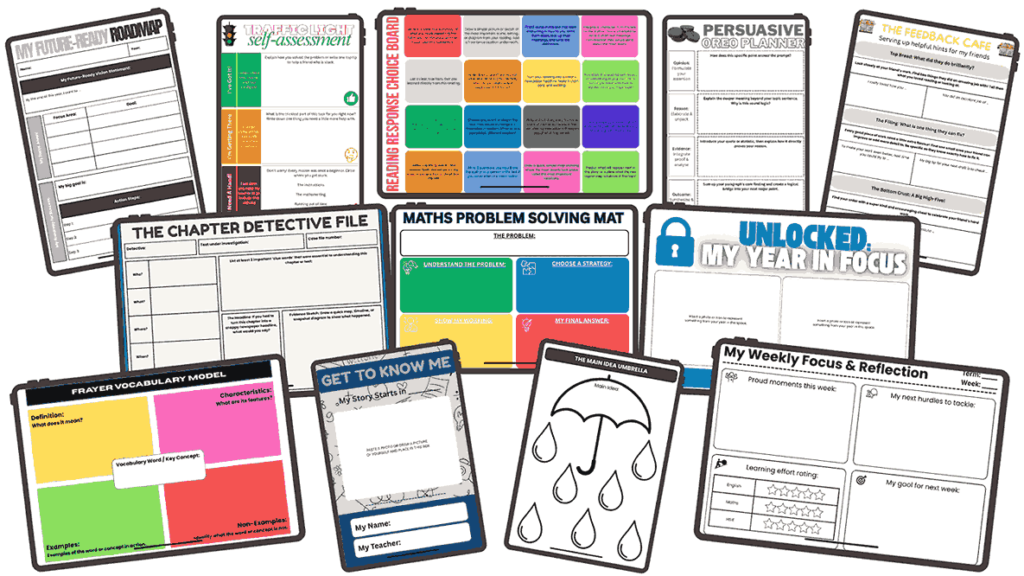
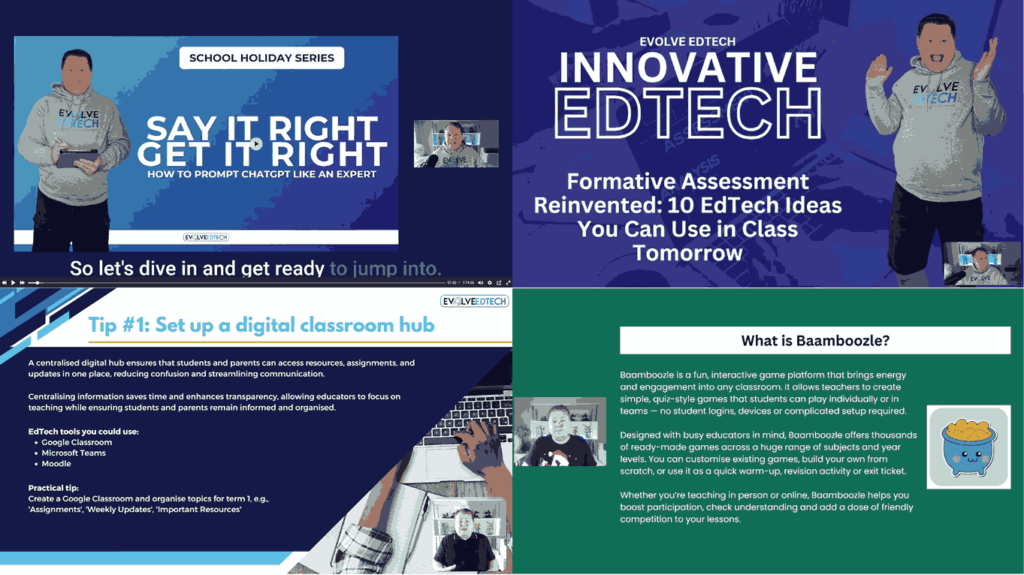
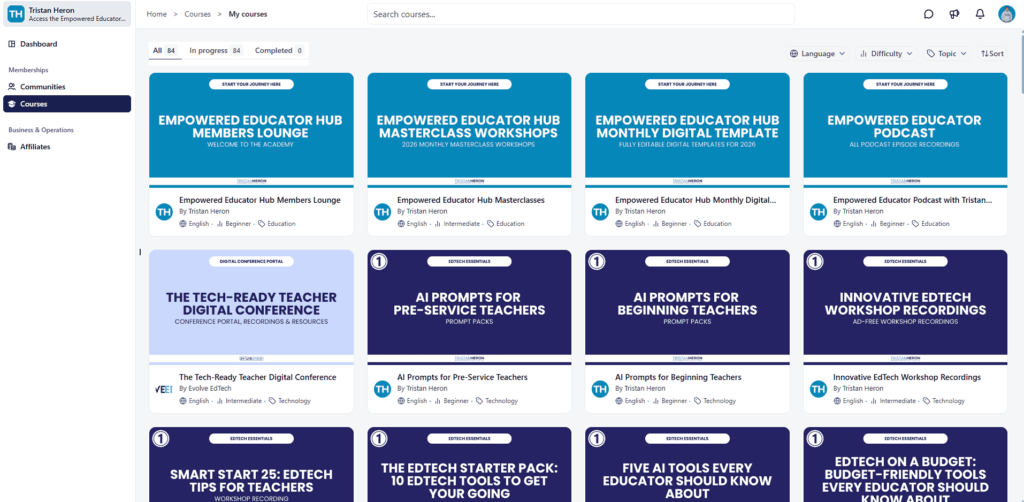
Today, Tristan puts these beliefs into practice through the Empowered Educator Hub, a membership made for educators. It includes eight learning modules, a new recorded masterclass every month, a member community and a full library of digital templates. The idea is to fit around a busy life.
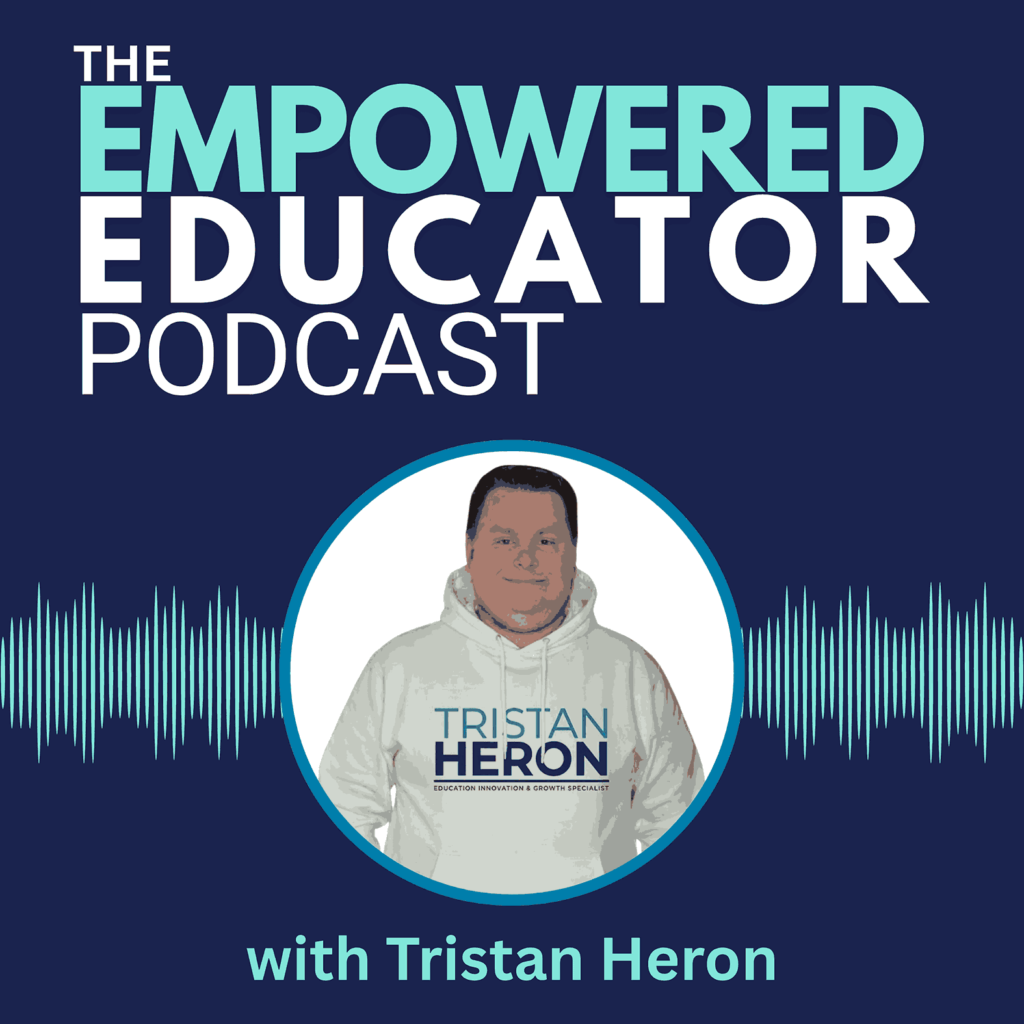
Around the Hub sits a wider set of free support. It includes his blog, videos, social media content, free teaching resources and the Empowered Educator Podcast. Tristan believes teachers should be able to benefit from his work whether or not they become paying members. He also creates ready-made digital templates that can be customised in Canva, along with AI prompt guides written for specific roles, from pre-service and beginning teachers to school leaders and principals. He works directly with schools and educators too, through professional development, workshops and conference sessions, where he goes beyond showing a tool and explores how it fits real classroom settings.
One rule runs through all of it. If he has not tested something in a real classroom, he does not recommend it. He knows that educators can tell when they are being sold to, and they can also tell when advice comes from someone who shares their reality. His focus is on teacher confidence rather than on the technology itself, because a confident and less tired teacher is one of the best gifts a classroom can receive.
Building the Hub has not been easy. Tristan has funded the work himself and has built it while teaching full time. There were moments when stopping would have been the easier choice. What kept him going was the thought of the teachers it could help, and the wish to create something made by someone who still plans lessons, marks work, answers emails and sits in meetings before trying to find the energy for the next big tool everyone is talking about.
His efforts have been recognised outside the classroom. In 2025, the Corporate Vision Education and Training Awards named his work the Leading Teacher EdTech Training Initiative. In 2026, he was recognised again as the Leading Teacher-Led EdTech Innovation Provider in Australia. Tristan is especially proud of the words teacher-led in that second award, because they capture what he has tried to build. He is not looking at education technology from the outside. He is facing the same challenges as the educators he supports.
Even so, awards are not the measure he watches most closely. The achievement he values most is much quieter. It is a teacher telling him that they tried something he shared on Monday, that it worked, and that they were able to leave school on time. For Tristan, the real test is simple. Are teachers getting time back? If an educator spends less of the evening formatting resources or fighting another platform, and more time teaching well, connecting with students or simply going home, then the work is doing its job.
AI is a very capable assistant. It is not the teacher.
Tristan has taken several leadership lessons from this journey. The first is to stay in the work. Because he still teaches, he finds it hard to give poor advice about a Year 11 class when he is teaching Year 11 the next day. The second is to choose practical over perfect. A useful template shared today can help more teachers than a flawless one shared next term. The third is to say no more often. As opportunities grew, he began testing each one against a single question: will it help more educators use technology with confidence? The fourth is to make the first step small, because people rarely need another hundred-slide presentation. They need to know where to begin.
Trust sits beneath all four lessons. Tristan does not want to stand at the front of the room and claim to have every answer. He would rather stand beside teachers, share what has worked, admit what has not, and help them find what suits their own context.
His vision for education is similar in tone. He does not expect the future to look futuristic. He expects it to look rather ordinary, with teachers spending less time on administration, formatting and repetitive tasks, and more time on what only a person can do. That includes knowing students well, building relationships, giving feedback that truly lands and noticing the student who has suddenly gone quiet. In his view, technology should create more space for the human side of education and never replace it.
He also hopes teachers will be trusted as professionals when it comes to technology. Schools do not need ten new platforms every year, he argues. Teachers need the freedom to choose a few tools that suit their students, subject and style. He adds that some of the best professional learning he has ever had did not come from a conference or an expensive course. It came from a colleague down the corridor sharing what had worked in their own class. Technology now lets that kind of sharing travel much further than one staffroom.
Technology is not the product. Teacher confidence is.
Looking ahead, Tristan plans to make the Empowered Educator Hub even more useful for current members and easier for new ones to join. He wants teachers to arrive with a problem and quickly find something practical. Professional learning does not always need to be a six-hour course, he says. Sometimes the most valuable thing is an idea that can be understood in ten minutes and used the next day. He is also preparing to launch the Empowered Educator Podcast. It will run in four seasons each year, matching the Australian school terms, with episodes of about 30 minutes. It can be found at tristanheron.com/podcast.
In the longer term, he wants to help more educators share what they know. A great deal of expertise sits inside classrooms and rarely travels beyond the staffroom door. Tristan would like to create more chances for those voices to be heard. His own aim is modest and specific. He wants fewer teachers to feel they are falling behind. He wants more teachers to feel confident with the handful of tools that truly suit their classrooms. And he wants technology and AI to give back some of the time that has slowly disappeared from the profession.
His message to any teacher who feels that technology is moving faster than they can follow is a calming one. You do not need to know everything. You only need somewhere to start. For many educators, that starting point is the Empowered Educator Hub, which is available at tristanheron.com/hub. In a field full of noise, Tristan Heron offers something steadier: a working teacher, sharing tested ideas, in the hope that every educator can teach well and still make it home on time.