
Teresa Sacco | Public Accountant | Das Timing
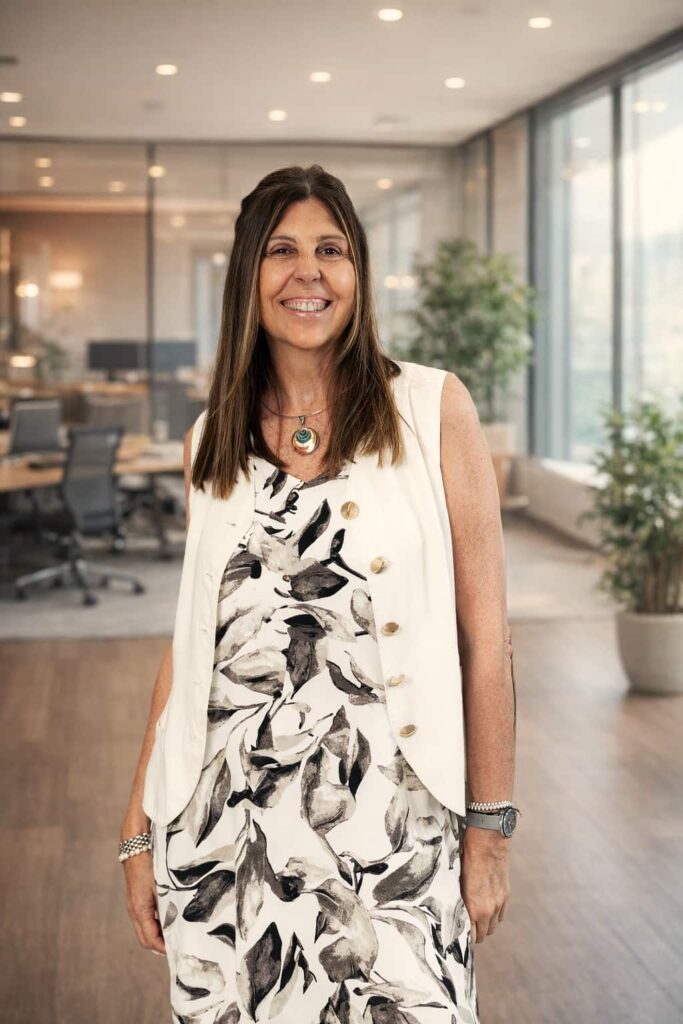
Teresa Sacco is a Master Professional Coach (MCC), Das Timing Consultant, Certified Public Accountant, and consultant in leadership and human development. Her professional journey is the result of years of study, reflection, and practical experience across different disciplines. She holds an International Postgraduate Degree in Strategic Management and completed negotiation training at Harvard. She is also an international speaker, recognized for her clarity of thought and her ability to connect strategy with human depth. At EliteX, we are proud to have Teresa Sacco as Cover Story of the edition: Transformational Female Coaches to Follow, 2026.
Her academic and professional training is extensive and multidisciplinary. She is certified as a Coaching Supervisor and as a Professional Medical Coach by the Medical Coaching Institute in Israel. She is a Master Trainer in Neuro-Linguistic Programming in the United States and a facilitator of the LEGO SERIOUS PLAY methodology. In her search to contribute to education from a different perspective, she obtained international certification as a Neuro-Educator and also developed herself as a scientific-emotional graphologist. This combination of disciplines allows her to approach leadership and transformation from a systemic and integrated point of view.
True leadership begins when we stop reacting and start choosing with intention.
Throughout her career, Teresa has received important recognitions. She has been named Honorary Academic Doctor and Honorary Member of the International Academy of Diplomacy and Professions. Due to her commitment to social coexistence and sustainable development, she has been distinguished as an Illustrious Woman of Argentina. She was also recognized as Leadership Coach 2024 at a global level by CEO Today Executive Coaching Awards. These recognitions are meaningful to her, but she considers them a consequence of consistent work rather than the main objective of her career.
Before fully dedicating herself to coaching and consulting, Teresa built a strong foundation as an accountant within organizations. That experience allowed her to understand structures, processes, financial logic, and institutional dynamics. When she later integrated Executive, Team, and Organizational Coaching into her work, she did not abandon her analytical background. Instead, she combined both worlds. She developed a systemic approach that connects strategy, numbers, people, culture, and emotional health. For her, personal transformation, organizational change, and community development are not separate realities but interconnected dimensions of the same process.


Her work focuses especially on conscious leadership, emotional health, and meaningful decision-making. She believes that leadership is not only about achieving results but also about understanding the impact of decisions on oneself and on others. She has worked with leaders, management teams, teachers, social organizations, independent professionals, and individuals who are going through deep life changes. In every case, she starts from the same principle: human development cannot be fragmented or reduced to isolated techniques.
Her inspiration to become a coach began more than twenty years ago during a turning point in her own life. Both in her personal and professional context, she experienced a profound break that forced her to rethink her direction. At that same time, she encountered Neuro-Linguistic Programming, which changed the way she understood language and reality. She realized that words are not neutral. They shape perception, influence relationships, and create possibilities or limitations. Through this learning, she clarified her beliefs and began to align her path with her life purpose.
At the same time, she became deeply interested in neuroscience. Understanding why people act the way they do and how change occurs at a neurological level gave her a more solid foundation. She started to observe herself and others differently. Throughout her professional career, she saw many highly skilled and intelligent individuals who were exhausted, disconnected, or trapped in decisions that did not reflect who they truly were. This observation strengthened her conviction that professional success without inner alignment leads to imbalance.
Conscious leadership means remembering who we are beyond our roles.

Teresa gradually articulated and integrated all her knowledge into a powerful methodology. She created spaces for reflection, awareness, and action, always aiming for transformations that are not only visible but sustainable over time. For her, real change is not about temporary motivation but about structural shifts in perception, responsibility, and decision-making.
She describes her coaching style as articulate, comprehensive, humanistic, and strategic. She works from deep, respectful, and committed listening. At the same time, she brings conceptual clarity and critical thinking into every process. She does not believe in universal recipes or quick formulas that promise immediate results. Each coaching process is unique and requires careful reading of context, personality, and life stage.
Her sessions combine reflection, practical tools, playful methodologies, and scenario analysis. She maintains a strong focus on personal responsibility and on awareness of the impact that decisions generate. To structure her work, she created the S.E.N.AA method, which consists of four phases. The first phase is to let go of what no longer serves. The second is to focus on a clear objective with direction. The third is to nurture the path positively, strengthening internal and external resources. The fourth is to analyze and adjust with clarity, raising perspective and expanding vision. This method allows clients to move from confusion to structured action without losing depth.
She mainly works with leaders and management teams, educators, independent professionals, social organizations, and individuals who are redefining their personal or professional paths. Many of her clients are going through migration processes, career transitions, educational leadership challenges, or organizational transformations. They usually arrive with high internal standards and strong commitment to their environment, but also with a deep need for meaning. Often they feel that traditional models no longer provide sufficient answers.
One of the main challenges her clients face today is emotional overload. They operate in environments of high uncertainty, constant demand, and pressure for immediate results. This context creates difficulty in making clear decisions, maintaining healthy relationships, and exercising consistent leadership without falling into burnout. Many also experience a loss of meaning, a disconnect between what they do and what they truly want. In organizations, she frequently observes difficulties in designing and following clear processes, with proper controls and measurable outcomes.
To help her clients overcome these challenges, Teresa works through structured processes that integrate awareness, focus, internal resource development, and contextual analysis. She emphasizes the importance of reading the scenario accurately and assuming responsibility. Her objective is not to eliminate difficulties, because she understands that uncertainty is part of life. Instead, she strengthens her clients’ capacity to navigate complexity with clarity, balance, and coherence. When individuals understand from where they decide and for what purpose they act, they regain autonomy and direction. For her, conscious leadership means remembering who one is beyond roles and titles.

Human development cannot be fragmented or reduced to isolated techniques.
Throughout her journey, she has accompanied leaders and teams who were deeply worn out, with high levels of internal conflict and disorganization. Through structured measurement at the beginning of each process and continuous evaluation of progress, these teams transformed into more collaborative and effective work environments. She has also supported migrants who, after experiencing profound grief, managed to rebuild their identity and redefine their life project. Some clients have written to her years later to share that they achieved goals defined together during sessions that included playful and creative methodologies. For Teresa, success is not only external achievement but the internal transformation that sustains it.
What differentiates her approach is comprehensive articulation. She does not separate the personal from the professional or the emotional from the strategic. She integrates leadership, education, processes, emotional health, and social context within the same framework. She believes that any coaching process that ignores these dimensions risks being superficial and unsustainable. Human beings do not function in parts, and therefore coaching should not either.
In her framework, she integrates five axes: scenario reading, appropriate leadership level, developed and undeveloped skills, the leadership philosophy required at a specific moment, and the leadership archetype structured through the S.E.N.AA method. This model allows her to adapt to each context without losing coherence.
She measures success by the quality of decisions her clients make and the coherence between what they think, feel, and do. She observes improvements in relationships and the sustainability of changes over time. In organizational contexts, she uses KPIs and OKRs to make results visible and measurable. At the same time, constant recommendations and word of mouth are indicators that her work generates trust and impact.
Her daily habits reflect the same principles she teaches. Conscious reflection is fundamental in her life. She maintains a systemic perspective, observing her external reality to understand her internal state. She dedicates time to study, silence, and reviewing her alignment with her purpose. Writing, genuine human contact, and critical observation of reality help her organize thought, emotion, and action. For her, coherence between thinking, speaking, feeling, and doing is essential.
She continues to improve her skills through constant training, supervision, research, and writing. She believes that professional experience, when critically reviewed, is one of the greatest sources of learning. Continuous improvement is not optional but an ethical responsibility.
To women who want to become coaches, she advises authenticity. She encourages them not to copy external models or styles that do not belong to them. She emphasizes the importance of solid training, independent judgment, and valuing life experience as part of professional capital. For her, coaching requires presence, ethics, and depth. Authenticity is an asset that generates impact beyond technical knowledge.
Leadership is not only about achieving results but about understanding the impact of our decisions.
She acknowledges the influence of her parents, who were inspirational leaders by nature. From them, she learned that leadership is service, grounded in critical thinking, ethics, and humanity. She has also been influenced by teachers and role models in conscious leadership and transformative education, always maintaining a reflective and open perspective.
Looking ahead, Teresa aims to expand the institutional and international impact of her work. She seeks to strengthen educational proposals and consolidate methodological frameworks that articulate leadership, emotional health, and social transformation. She believes the future of coaching lies in generating real, responsible, and contextualized impact. Her path is oriented toward leaving a legacy of true transformation, understanding that while not everything can be controlled, it is possible to awaken in others the desire to build something greater than themselves.
Her message to readers is clear. Leading one’s own life is an act of conscience and responsibility. It is not about having all the answers but about daring to ask the right questions and sustaining processes with humanity and meaning. True leadership begins when people stop reacting automatically and start choosing with intention, vision, and trust in the process.