
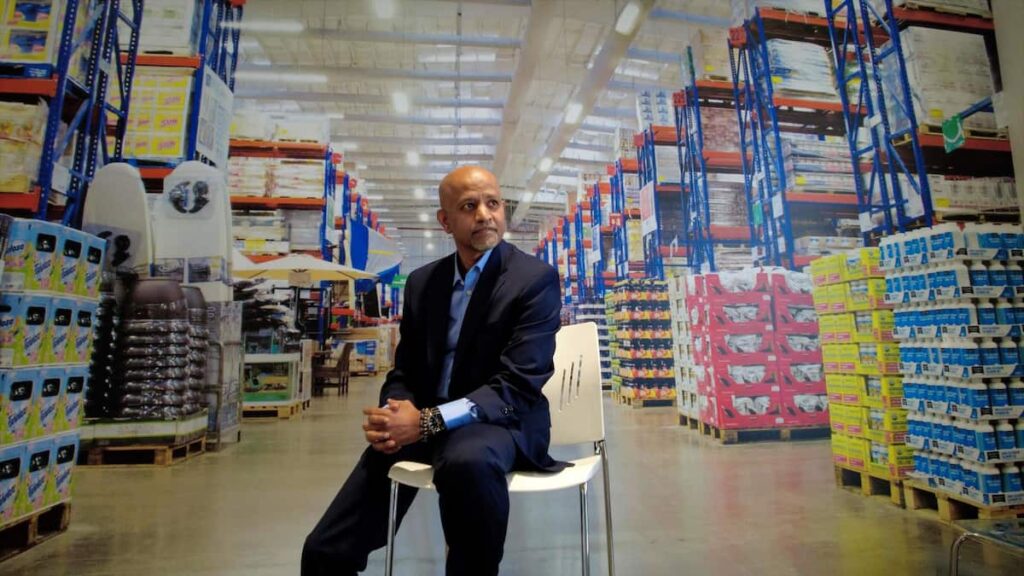
Vishwanath Krishnamoorthy | PriceSmart | AVP, Global Logistics, Planning, Process and Optimization
Vishwanath Krishnamoorthy has built a career around understanding how supply chains work, identifying opportunities for improvement, and helping businesses make better decisions. With more than 20 years of experience in supply chain design, analytics, optimization, and strategy, he brings together practical experience, analytical thinking, technology, and business understanding. Today, he serves as AVP of Global Logistics, Planning, Process, and Optimization at PriceSmart, where he focuses on designing, planning, and improving supply chain operations across markets.
His journey into supply chain began in India after completing his education in Chemical Engineering. His first professional role was as a sales and operations technologist, where he worked with forecasting, order scheduling, and inventory while helping ensure that products reached customers when they were needed. The experience was highly practical, involving work on the shop floor and in distribution centers. It gave him an important early lesson: a plan is valuable only when it works in the real world.
As his interest in supply chain grew, Krishnamoorthy pursued a master’s degree in industrial engineering with a focus on supply chain. He later completed an MBA in Management Information Systems because he recognized the importance of connecting business knowledge with technology. For him, technology offered a bridge between supply chain operations and business strategy.
Data should inform judgment, not replace it.
His career then expanded into consulting across industries and geographies. This experience helped him develop strong capabilities in analytics, network design, and supply chain strategy. He later built a supply chain analytics practice at L Brands, supporting well-known brands such as Victoria’s Secret and Bath & Body Works. He also worked with Chewy during a period of rapid growth. Each role added another layer to his understanding of supply chain management, from seeing how physical networks operate to modeling them, translating analysis into decisions, and developing teams and capabilities.
What continues to attract Krishnamoorthy to supply chain is its complexity. Something as simple as seeing a product on a store shelf can involve months of planning across demand, sourcing, inventory, transportation, and distribution. From the customer’s perspective, the expectation is straightforward: the product should be available when and where it is needed. If it is not there, a business can lose the sale. This connection between complex operations and simple customer expectations has remained a strong source of motivation throughout his career.
He sees today’s supply chains as increasingly complex and dynamic. Rather than functioning as a simple chain, modern supply networks behave more like living systems, where a change in one area can create ripple effects across another. Customer expectations for greater convenience, changing demand, trade policies, and weather-related transportation disruptions can all occur at the same time. This makes it important for organizations to balance cost, service, speed, flexibility, and resilience.
Supply chain is about making the whole system work better.

For Krishnamoorthy, improving efficiency does not simply mean reducing financial costs. Cost can also appear through time, capacity, flexibility, complexity, risk, or customer experience. Therefore, the right solution is not always the cheapest option. Instead, businesses need to understand the wider trade-offs and determine which decision creates the best result for the overall system. Analytics, modeling, and scenario analysis help make these trade-offs clearer and support better decisions.
He takes a similar approach to disruption. Rather than trying to eliminate every possible disruption, he believes organizations should understand their vulnerabilities and prepare different response options. Scenario modeling should be a regular capability rather than something used only when making major decisions. The objective is not to predict every disruption, but to ensure that a business does not have to start from zero when unexpected events occur. In his view, resilience is the ability to adapt when reality does not follow the plan.
Technology and AI also have an important role in this approach. Krishnamoorthy views technology as an enabler rather than the final objective. Its value comes from what it allows businesses to accomplish, including improving visibility, evaluating more choices, understanding trade-offs, and processing information at a much larger scale. At the same time, he believes technology must be supported by the right context and assumptions. Data should inform human judgment rather than replace it. The greatest opportunity lies in using technology to ask better questions and reach stronger decisions with greater confidence.
Some of his proudest professional moments have come from taking unclear business questions and turning them into decisions that organizations can act on. Whether determining where to open a new location, transforming the supply chain network, or solving a complex business problem without an established playbook, he focuses on understanding what truly matters, bringing together the right perspectives, and translating data into meaningful business outcomes. The impact of good decisions can ultimately mean lower costs, less time, better service, greater flexibility, and significant financial value.
Resilience means adapting when reality does not follow the plan.
Beyond business results, Krishnamoorthy places strong importance on people development. He is proud of the teams he has built and coached and finds satisfaction in watching people grow into professionals who can solve problems independently. His leadership approach is based on challenging traditional ways of working, understanding processes from the ground up, and simplifying complex ideas so people can understand why a decision matters.
For young professionals entering supply chain, his advice is straightforward: remain curious, ask questions, take risks, and find a mentor. He encourages professionals to explore different areas of supply chain and understand how decisions connect across the wider system. He also emphasizes communication, because technical solutions have limited value if their trade-offs and business impact cannot be explained clearly. Through this combination of curiosity, practical understanding, analytical thinking, and people development, Vishwanath Krishnamoorthy continues to approach supply chain as a discipline where better questions can lead to better decisions and stronger businesses.