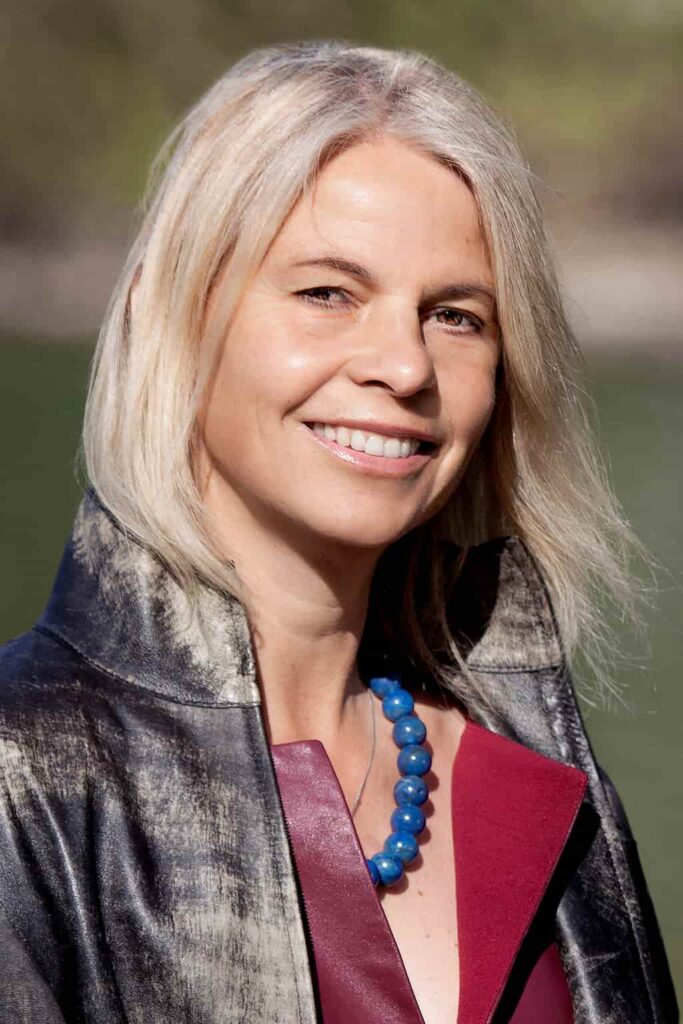
Dr. Karen Wendt has built a career around understanding how finance works and then finding ways to make it more future-ready, inclusive, and sustainable. After a successful career in investment banking, she transitioned from Managing Director to CEO of Eccos Impact GmbH, President of SwissFinTechLadies and Sustainable Finance, angel investor, and editor of Springer Nature’s Sustainable Finance series. Across these roles, her work brings together capital, technology, knowledge, and people who may otherwise never have the opportunity to connect.
Dr. Karen Wendt | CEO | Eccos Impact GmbH | President of SwissFinTechLadies and Sustainable Finance
She describes herself as an ecosystem architect who focuses on transformation, capital flows, value alignment, market failures, and information asymmetry.
EliteX proudly features Dr. Karen Wendt in this edition, recognizing a distinguished journey of leadership, innovation, and meaningful impact.
Her professional journey began with a desire to understand the world of finance from the inside. Investment banking gave her an opportunity to learn the language, structures, and systems that influence how capital moves through the economy. She entered the field determined to decode what often appeared to be a closed and complicated system. Over time, understanding the system was not enough. She wanted to help change it. Her leadership journey therefore grew naturally from observing existing structures to questioning whether they were still fit for the future.
Real impact begins when a solution is ready to scale.
This approach has shaped her leadership philosophy. Wendt believes in participative leadership, but she does not see participation as simply reaching consensus. For her, effective collaboration requires trust, shared values, clear responsibilities, and measurable outcomes. Teams need to understand who is responsible for what, when it needs to be delivered, how it should be done, and how success will be measured. Her approach can be described as being soft on people while remaining hard on outcomes. She believes that strong teams develop through different stages, from forming and storming to norming and performing, and that thoughtful leadership is essential at every stage.
Among the professional achievements she values most is her contribution to bringing environmental and social risk measurement into banking risk models and core banking risk architecture. Her work has been connected with important frameworks and standards, including the Equator Principles, Impact Principles, and the World Bank’s Environmental and Social Performance Standards. For Wendt, sustainability cannot remain a separate discussion outside financial decision-making. Environmental and social factors need to become part of credit, investment, and rating decisions because these factors can influence both risk and long-term value.
She is also proud of building Springer Nature’s Sustainable Finance series, which she sees as an important platform for forward-looking research and knowledge. Completing her PhD in the middle of her professional career is another achievement that reflects her belief in continuous learning. Her academic and professional work reinforce each other, allowing her to connect research with practical developments in finance and investment.
Wendt stays ahead of change by trying to live upstream of consensus. Through her work with professors and researchers connected to Springer Nature, she is exposed to ideas before they become widely accepted management trends. Her role as an angel investor and jury member gives her another perspective, as she encounters emerging technologies and business models while they are still at the pitch-deck stage. This combination allows her to identify structural changes early rather than simply following established trends.
Like any transformation-focused leader, she has faced resistance. Wendt believes that people often resist change because they fear losing stability or control. Instead of trying to suppress that resistance, she uses mediation, principled negotiation, and ideas from game theory to make interests, consequences, and possible outcomes clearer. She believes that curiosity, flexibility, critical thinking, and trust are essential when organizations are going through change. Constant communication helps create the confidence people need to move forward.
Innovation, in her view, often happens at the boundaries between disciplines, industries, regions, and different ways of thinking. Organizations need silos for stability, but those silos can become barriers when they prevent collaboration. Wendt therefore focuses on connecting people who would not normally work together, including competitors. She sees value in what can be called co-frenemy relationships, where organizations compete in some areas while cooperating to build markets or solutions that neither could create alone. This approach reflects her belief in multi-actor networks and the power of collaboration across traditional boundaries.
Leadership means turning resistance into movement and ideas into action.
Her approach to sustainable growth is equally practical. She believes growth should begin with a real problem, followed by a hypothesis, a minimum viable product, market testing, evidence, and iteration. Only after learning what works should an organization scale. Traditional measures such as total addressable market, serviceable available market, and serviceable obtainable market remain important, but she believes learning speed can be even more valuable. For her, growth is not simply becoming bigger; it is discovering what deserves to become bigger. As an impact investor, she emphasizes that solving a social problem is only the beginning. Real impact comes from scaling solutions so that they can reach many more people.
Wendt also believes that organizational culture and business performance cannot be separated. Toxic cultures are not only harmful to people; they are economically irrational. Purpose, trust, and shared values can create commitment and energy, but they should never become excuses for constant overwork. She believes leaders should pay attention when employees no longer have enough time for family, relationships, rest, or recovery. Staying grounded is essential for sustainable leadership.
Looking toward 2026 and beyond, Wendt sees major opportunities in tokenization, fractional ownership, and private markets. Tokenization can make traditionally illiquid assets more divisible, transferable, and accessible. However, she warns that greater access alone does not create a better market. If information asymmetry remains high, tokenization could simply democratize opacity rather than democratize opportunity. She believes the next frontier lies in building better markets and developing strong stewardship around them.
For aspiring executives, Wendt’s message is simple: remain curious and stay grounded. She encourages future leaders to ask themselves what they would do if they had all the courage in the world. She also believes leaders should look beyond individual performance problems. When an employee underperforms, leaders should ask not only what went wrong with the employee but also whether leadership contributed to the situation. For Wendt, leadership at a high level requires deep self-reflection at ground level.
Her vision for the coming years is focused on democratizing impact investing and private markets. She wants to address a double market failure: there are too few female founders and too few female investors, while information asymmetry continues to prevent impact investing from scaling effectively. Her goal is to enlarge both the market and the investor community. Beyond finance, she is also increasingly interested in longevity and quantum technology, particularly in how artificial intelligence and quantum technologies could help healthcare move from treating disease toward preventing it. Across all these interests, one idea remains central to her leadership journey: the future belongs to those who can connect people, capital, knowledge, and technology to build systems that create lasting value.
Capital creates impact when it is connected to purpose, knowledge, and scale.