Press Release
Official Press Release:
Date Release:
How Cybersecurity Leadership Is Evolving
July 2026/EliteXPress/ – How Cybersecurity Leadership Is Evolving in the Age of AI and Digital Resilience
Cybersecurity leadership is shifting from preventing every attack to keeping critical financial services secure and available during disruption. As Artificial Intelligence (AI) accelerates innovation and cybercrime, operational resilience is becoming a core business capability.
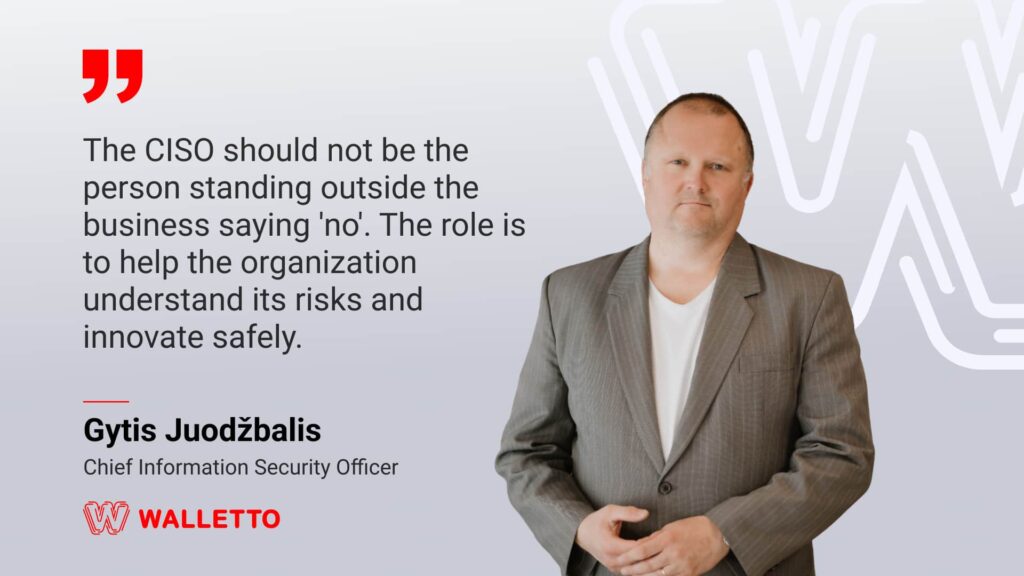
To better understand how these changes are shaping the industry, we spoke with Gytis Juodžbalis, Chief Information Security Officer (CISO) at WALLETTO, who shared his perspective on cyber resilience, AI, regulatory change, and the future of cybersecurity leadership.
Cybersecurity Is Becoming a Business Resilience Challenge
Organisations should focus on how quickly they can detect, contain, communicate, and recover from an incident.
According to Gytis, organizations should no longer ask whether they can prevent every cyberattack.
“No organisation can prevent every attack. The real question is whether you can detect it early, limit the damage, continue critical operations, communicate effectively, and recover quickly.”
People Can Become the Strongest Security Control
Attackers exploit trust and urgency to induce payments, information disclosure, or unauthorised access.
“I don’t like describing employees as the weakest link,” Gytis explains. “When someone questions an unusual request, verifies it through another channel, or reports a suspicious email, that person becomes one of the organisation’s strongest controls.”
At WALLETTO, practical training, phishing-resistant authentication, verification procedures, and a culture that challenges suspicious requests turn awareness into an active defence.
Artificial Intelligence Creates Both Opportunity and Risk
Security teams use AI to analyse alerts, detect anomalies, and prioritise risks. Criminals use it to create convincing phishing, deepfakes, and automated fraud.
“The question is not whether AI is good or bad. The question is whether it is introduced with proper governance, access control, data protection, and human accountability.”
Approved tools, clear data-handling rules, access controls, logging, and human oversight can improve productivity without creating unmanaged risk.
DORA Is Raising the Standard for Operational Resilience
The Digital Operational Resilience Act (DORA) requires financial organisations not only to prevent incidents but also to prepare for disruption.
“DORA should never become a paperwork exercise. Its real value comes from testing whether the organisation can actually continue operating during a serious disruption.”
Technology, security, risk, compliance, operations, and leadership must align recovery plans, supplier management, incident response, and resilience testing in practice—not only on paper.
Security Must Be Built Into Financial Products
Customers expect fast services, yet fintech platforms process sensitive data and move money, making them attractive targets.
Protective measures should therefore be embedded from the outset, not added shortly before launch.
“Security must be designed as part of the product itself. Customer trust is not separate from the product—it is part of the product.”
Authentication, fraud prevention, secure development, monitoring, access management, and data protection must span the product lifecycle.
Third-Party Risk Continues to Grow
Financial services depend on cloud providers, software vendors, payment processors, and other external partners.
A security incident affecting one supplier can quickly affect many organisations, even when their own infrastructure remains secure.
Critical Information and Communication Technology (ICT) providers need thorough checks, clear contractual obligations, ongoing monitoring, prompt incident reporting, resilience testing, and practical recovery and exit plans.
Organisations may outsource services, but they remain accountable for the associated risks.
Privacy and Trust Go Hand in Hand
At WALLETTO, privacy starts with knowing what data is collected, why it is needed, who can access it, and when it is deleted.
“In many cases, one of the most effective ways to reduce risk is simply not retaining information the business no longer needs.”
Reducing unnecessary data exposure strengthens both security and customer confidence while supporting long-term compliance with data protection requirements.
The Future of Cybersecurity Leadership
Today’s CISO connects cyber risk with regulatory obligations, customer confidence, supplier oversight, operational continuity, and innovation.
Boards need decision-oriented insight into critical services, exposure, control effectiveness, recovery capability, residual risk, and investment priorities.
“The CISO should not be the person standing outside the business saying ‘no’. The role is to help the organisation understand its risks and innovate safely.”
The future CISO will be measured by the organisation’s ability to make informed risk decisions, maintain critical services, preserve customer confidence, and recover decisively.
About EliteX
EliteX is a global business media and recognition platform dedicated to spotlighting influential leaders, innovators, and changemakers across industries. Through curated editorial editions and feature stories, EliteX celebrates excellence, leadership, and impact that inspire audiences worldwide.
Media Contact:
Press Office
info@theelitex.com
www.theelitex.com