Press Release
Official Press Release:
Date Release:
The New Rules of Work in Fintech: Why Talent Is Reshaping the Industry From the Inside
Feb 2026/EliteXPress/ – Fintech moves fast. Roles evolve faster. And somewhere between regulation updates, product launches, and market expansion, a quiet shift is changing how companies actually function from the inside.
The old picture of leadership as a rigid hierarchy is fading. Employees are no longer waiting to be managed, and managers are no longer expected to have all the answers. Instead, fintech teams are redefining what authority, growth, and collaboration look like in real time.
As Lithuania strengthens its position as one of Europe’s most active fintech ecosystems, companies are facing a new challenge. Winning talent is no longer only about salary or titles. It is about creating environments where expertise is trusted, voices are heard, and leadership feels human rather than distant.
WALLETTO, a top 10 Lithuanian electronic money institution operating in a highly regulated fintech environment, is navigating this transformation while continuing to scale. Speaking with WALLETTO’s Head of HR, Egle Ermanaite, revealed how deeply these changes are reshaping everyday work – and why people strategy is becoming inseparable from business resilience.
Are companies still shaping talent, or is talent shaping companies today?
Egle Ermanaite:
It is no longer a one-directional process. Companies influence talent, but talent increasingly influences companies as well. In fintech, expertise can be extremely niche, and when you want to attract professionals with specialised regulatory or technical knowledge, you have to build an environment where people feel they can grow and bring their own perspective into the organisation.
At WALLETTO, this means being open to adjusting internal processes when necessary. We operate in a regulated environment, but regulation should not prevent adaptability. Stability is important, yet flexibility is becoming even more critical when competing for highly specialised talent.
In markets like Lithuania, competition for skilled professionals is strong. Companies that want to expand their teams often need to rethink how flexible they are and how open they are to change. Stability is important, but adaptability is becoming even more critical.
The shift reflects a broader industry trend. As fintech matures, professionals are looking not only for stability but for workplaces where their voice carries weight. Companies that recognise this are starting to rethink internal structures, moving away from rigid hierarchies toward more collaborative models.
How is this changing the way employers think about employees?
Egle Ermanaite:
One of the biggest shifts is that employees are no longer seen simply as resources that execute tasks. In fintech, they are strategic contributors to growth. At WALLETTO, HR is closely aligned with leadership decisions because people strategy directly affects business outcomes. The industry moves quickly, and companies rely on people who can anticipate challenges, understand regulation, and bring fresh thinking.
When leadership starts viewing employees as partners in shaping direction rather than just filling positions, the dynamic changes completely. It becomes less about hierarchy and more about collaboration, where expertise drives progress.
Across the fintech ecosystem, this mindset is becoming more visible. Organisations that invest in long-term employee development often find themselves better prepared for sudden regulatory changes or market shifts, proving that people strategy is closely tied to business resilience.
When does retention actually begin?
Egle Ermanaite:
Retention starts much earlier than most people expect. It begins before the first interview, with how a company communicates publicly and how it presents its culture. A job description, employer reputation, and transparency all influence whether a candidate feels connected from the start.
From there, every interaction becomes part of the retention journey. Interviews, onboarding, and daily communication shape how employees experience the company. In fintech, where opportunities are always present, retention is not a single initiative but a continuous process.
Her perspective highlights how employer branding has become inseparable from HR strategy. Candidates today often research companies long before applying, meaning that culture is communicated long before the first conversation takes place.
What assumptions about work are quietly disappearing?
Egle Ermanaite:
The idea that productivity depends on physical presence is fading. The pandemic showed that trust and accountability matter more than location. Many professionals now expect flexibility, and companies are learning to measure outcomes rather than hours spent in the office.
Another change is the belief that career growth must always lead to management. More specialists are choosing to deepen their expertise instead of leading teams, and organisations are recognising that horizontal growth can be just as valuable as vertical promotion.
Leadership itself is evolving too. Strong managers do not need to know everything. They create environments where different strengths come together, and where expertise across the team drives success.
This transformation is not limited to fintech, but the sector’s fast pace makes these shifts more visible. Companies that once relied on traditional hierarchies are now experimenting with flatter structures and more collaborative leadership styles.
How is modern hierarchy changing inside fintech teams?
Egle Ermanaite:
The traditional image of a strong, distant authority figure is slowly disappearing. In modern fintech teams, leadership is becoming less about control and more about connection. A manager is no longer the “big boss” who has all the answers, but the person who creates clarity, supports decision-making, and brings the right people together at the right time.
In highly specialised environments like fintech, it is natural that team members often hold deeper expertise than their manager in certain areas. The strongest leaders are not threatened by this. They build teams where knowledge flows in every direction and where leadership is shared through trust rather than enforced through hierarchy.
This shift changes how teams operate. Instead of rigid top-down structures, organisations are moving toward models where managers act as facilitators and strategic guides, supported by professionals who actively shape outcomes alongside them. The result is a more human and resilient form of leadership, where success is driven not by authority but by collaboration and mutual respect.
At WALLETTO, managers act as facilitators and strategic guides, while specialists actively shape outcomes alongside them. In an industry defined by speed and complexity, sustainable success ultimately depends on something deeply human — the ability to build teams that grow together, learn continuously, and move forward with shared responsibility. The evolution of hierarchy reflects a broader industry mindset. As fintech becomes more complex, leadership is no longer about standing above the team but standing with it.
At WALLETTO, what makes work feel meaningful rather than transactional?
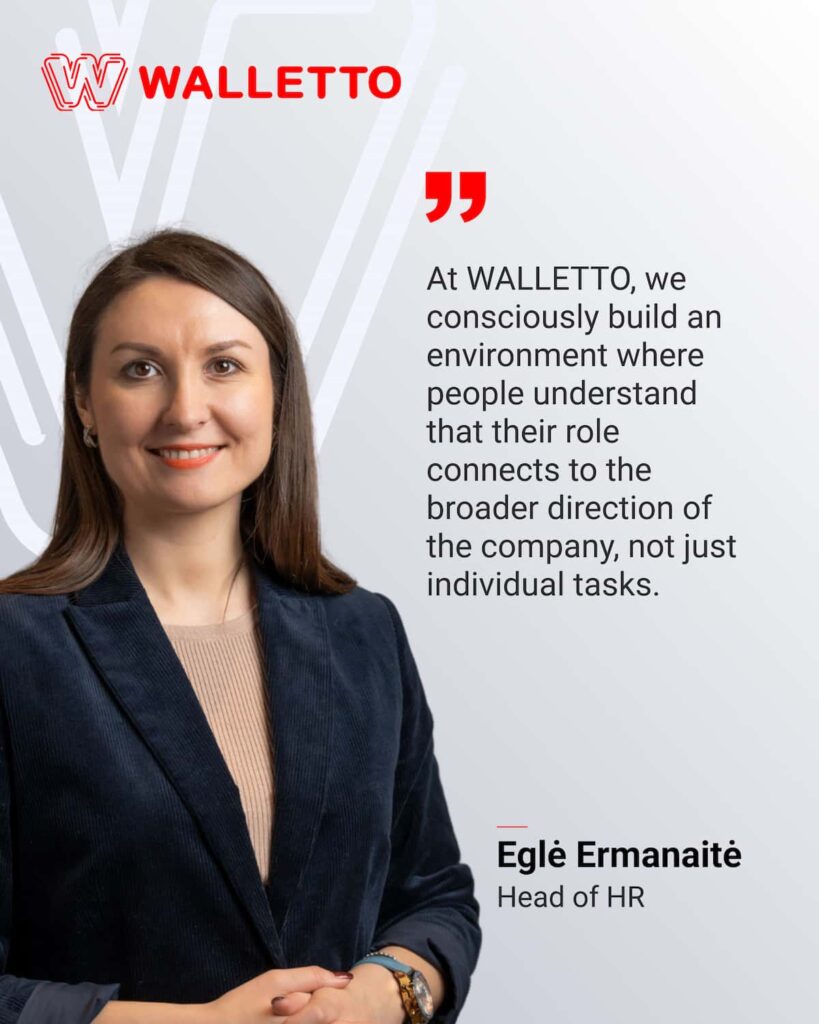
Egle Ermanaite:
At WALLETTO, we consciously build an environment where people understand that their role connects to the broader direction of the company, not just individual tasks. Fintech is a fast-moving and highly regulated industry, so meaningful work comes from knowing that your expertise directly influences how we grow, manage risk, and create value for clients and partners.
We encourage employees to take ownership, share ideas openly, and challenge existing processes when they see opportunities for improvement. When professionals feel their voice matters and their contribution has visible impact, work naturally becomes more purpose-driven and less transactional.
As the conversation came to a close, one theme remained clear. In an industry defined by rapid change, the companies that succeed will not only be those that innovate technologically, but those that understand how leadership itself is evolving.
As fintech continues to evolve, the biggest transformation may not be visible in technology alone, but in how organisations choose to lead and collaborate. The shift away from rigid hierarchy toward more human, trust-driven leadership is quietly redefining what success looks like inside modern teams. For companies like WALLETTO, adapting to this reality is not simply a trend but a long-term approach to building resilient organisations. In an industry built on constant change, the strongest advantage may no longer be speed alone, but the ability to grow together with the people who shape it. Shaping the Future of Global S-T-E-A-M Education”
Media Contact:
Press Office
info@theelitex.com
www.theelitex.com