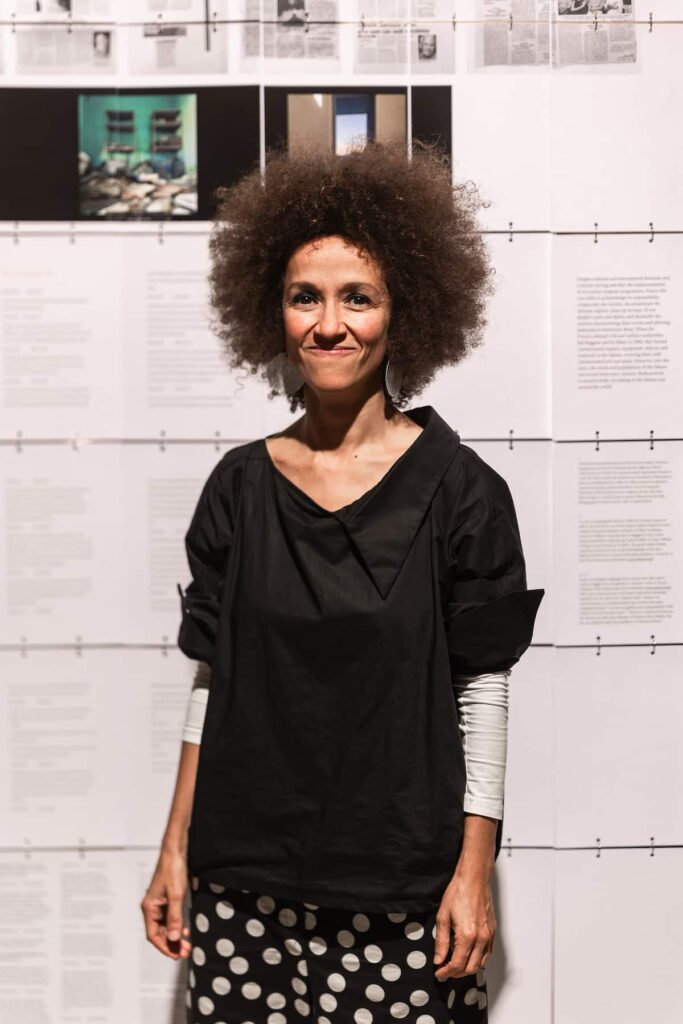
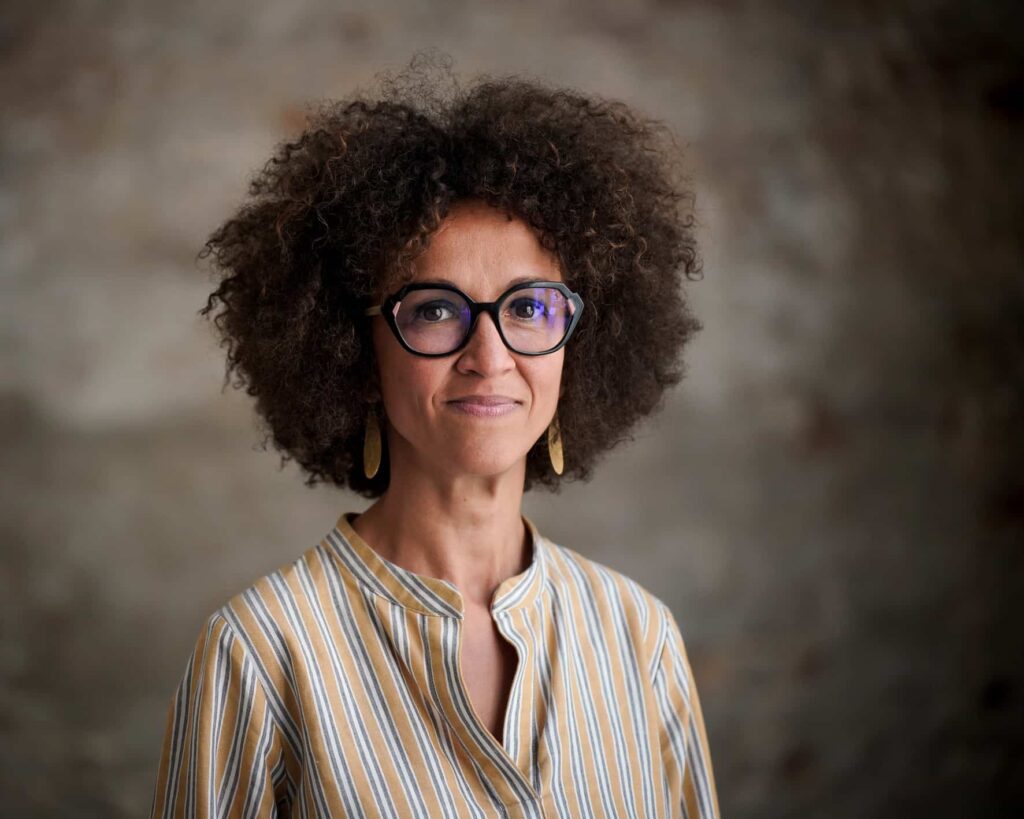
Samia Henni is an architectural historian, curator, and educator whose work examines the deep relationship between architecture, war, colonialism, and environmental destruction. Her research moves across books, exhibitions, lectures, and digital platforms. She is currently a professor at McGill University’s Peter Guo-hua Fu School of Architecture, where she teaches and continues to expand her long-term investigations into colonial violence and its spatial legacies. At EliteX, we are proud to have Samia Henni as part of the edition: Trailblazing Female Architects Shaping the Future of Architecture, 2026.
Saima Henni | Saima Henni
From early in her academic journey, she questioned the common understanding of architecture as something linked mainly to peace, design, and construction. She became interested in how architecture also operates as a tool of war and domination. Her first major book, Architecture of Counterrevolution: The French Army in Northern Algeria, examined how the French military used architectural planning and spatial organization during the Algerian War of Independence. Instead of focusing on ruins or destruction after conflict, she studied how architecture actively supported colonial control. This research showed that architecture was not neutral – it was deeply involved in political and military systems.
Decolonization is not a trend or a metaphor; it is a lifelong commitment to exposing and dismantling injustice.
Her edited volume War Zones expanded this discussion beyond Algeria. It brought together different perspectives to explore how war shapes space across various regions and histories. Through this work, she made clear that the connection between architecture and warfare is not an exception but a widespread condition. Planning, zoning, and infrastructure can all become instruments of violence.
Over time, her research shifted toward the environmental consequences of colonial warfare. This transition reached a powerful stage with Colonial Toxicity: Rehearsing French Radioactive Architecture and Landscape in the Sahara. In this dual book and exhibition project, she investigates the French nuclear weapons program in the Algerian Sahara and its long-lasting radioactive impact. Rather than using the language of military archives, which often refer to nuclear explosions as “tests,” she deliberately uses the word bombs. She shows how official terminology hides the human and environmental damage caused by these detonations.
Her research reveals that colonial violence is not limited to visible destruction. It also produces invisible forms of harm, especially through radiation. In the archives she studied, the word toxicity rarely appears. Instead, the documents focus on radioactivity in technical terms. By introducing the concept of colonial toxicity, she expands the discussion to include physical contamination, psychological trauma, restricted archives, and the silencing of victims. For her, toxicity is both material and symbolic. It affects landscapes, bodies, and memory.
In addition to this book, she edited Deserts Are Not Empty, which challenges the idea that deserts are empty or unused spaces. She demonstrates how deserts have often been treated as testing grounds for military experiments and extraction zones for resources such as uranium, oil, and lithium. These regions are frequently imagined as remote and disposable, yet they are deeply connected to global systems of power and technology.
Henni’s approach is not limited to traditional academic writing. She rethinks format and method. In Colonial Toxicity, the book contains hundreds of archival images accompanied by detailed captions. The captions sometimes carry as much weight as the main text. Because many institutional archives remain classified or difficult to access, she makes her work accessible and affordable so that scholars, activists, and affected communities can continue the research. The visual material is not decorative. It acts as evidence. Since radiation is invisible, images and documents become tools to materialize what cannot easily be seen.
Architecture is never neutral – it can construct homes, but it can also construct systems of control.
Her exhibitions function in a similar way. Performing Colonial Toxicity was first presented in Amsterdam and later traveled to other institutions. The exhibition space was designed to create a bodily experience. Sheets of paper suspended in space moved with visitors, suggesting the presence of radioactive dust. Through spatial installation, she transforms curatorial practice into a form of writing. The exhibition becomes another method of storytelling, one that engages emotion and physical movement.
Language plays a central role in her work. She studies how colonial administrations used what she calls cosmetic writing to rename and soften acts of violence. For example, wars were described as events, and bombs were called tests. Inspired by thinkers such as Frantz Fanon, she argues that decolonization requires confronting these linguistic strategies. She also proposes new terms, such as jerboasite, to name radioactive residues in the Sahara. By naming differently, she resists the normalization of harm.
Her intellectual practice is closely connected to lived experience. Having lived and worked in North Africa, Europe, and North America, she understands how colonial systems are structured across institutions and knowledge production. She has spoken openly about facing hostility and intimidation because of her research. For her, scholarship does not exist in isolation. It interacts with real political conditions. She insists that decolonial thought must move beyond fashionable terminology and toward concrete anticolonial action.
In interviews, she emphasizes collectivity and solidarity. She believes that dismantling colonial systems requires sustained effort across classrooms, publications, exhibitions, and public discussions. There is no simple formula. The work must be continuous and adaptable, as systems of power also adapt. For many communities, this work is not theoretical – it is about survival.
Today, Samia Henni stands as a leading voice in examining how architecture intersects with warfare, environmental destruction, and colonial governance. By combining rigorous archival research with experimental formats, she challenges both historical narratives and academic conventions. Her work invites readers and visitors to confront uncomfortable histories and to recognize that colonial toxicity is not confined to the past. It continues to shape landscapes, institutions, and bodies in the present.
Colonialism is not only about land and power, but also about the slow poisoning of landscapes and lives.