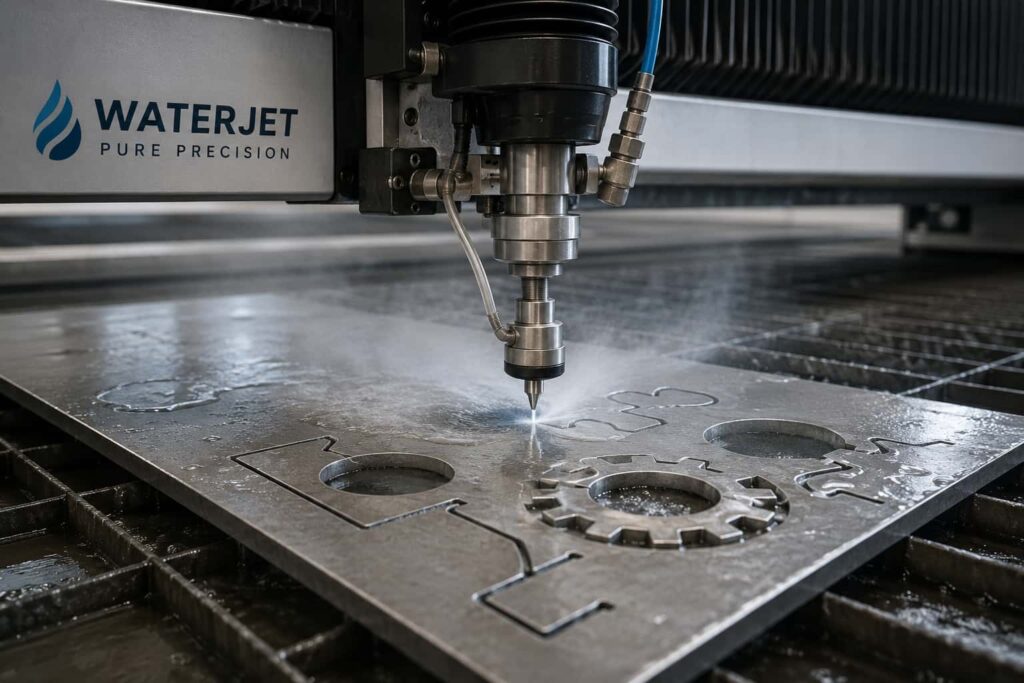
Precision is non-negotiable in industrial manufacturing. Whether you’re cutting aerospace components, medical device parts, or architectural metalwork, the question of how accurate a cutting process actually is — in the real world, not just on a spec sheet — matters enormously.
Waterjet cutting has a reputation for impressive accuracy, but that reputation comes with nuance. The technology is capable of exceptional results, and it’s also subject to a range of variables that affect the final outcome. Understanding what drives precision in waterjet work helps manufacturers know what to expect, what to ask for, and how to get the most from the process.
1. The Physics Behind the Cut
Before getting into variables, it helps to understand how the process achieves precision in the first place. A waterjet cutter uses an ultra-high-pressure stream of water — typically mixed with an abrasive like garnet — to erode material along a programmed path. There’s no blade deflection, no tool wear changing the cut geometry mid-job, and no thermal distortion to account for.
That starting point is significant. Many of the accuracy-limiting factors that affect other cutting methods simply don’t apply here, which gives waterjet a structural advantage when tight tolerances are required.
2. Positional Accuracy of the Motion System
The precision of a cut depends heavily on the precision of the machine guiding the cutting head. Factors like gantry rigidity, servo responsiveness, and motion control accuracy all influence how closely the machine can follow a programmed cutting path, particularly on intricate or high-tolerance parts. That is why manufacturers comparing industrial systems often pay close attention to the motion system itself when evaluating a water jet cutter, since it is one of the clearest technical differences between entry-level and production-grade equipment.
Companies like OMAX Corp, a Hypertherm Company, operate within that precision-focused segment of waterjet manufacturing, where motion control software and cutting-path optimization play a major role in overall machine performance and repeatability.
As manufacturing tolerances continue tightening across industries, machine intelligence and motion accuracy have become increasingly important to reducing rework and maintaining consistent production quality.
3. How Jet Lag and Taper Are Managed
Two phenomena specific to waterjet cutting affect edge quality and dimensional accuracy: jet lag and taper.
Jet lag occurs because the cutting stream slightly trails the motion of the cutting head, especially on curves and corners. In slower, more controlled cutting this is minimal, but at higher speeds it becomes noticeable.
Taper refers to a slight angle on the cut edge — the kerf is marginally wider at the top of the material than the bottom, caused by the stream losing energy as it travels through the workpiece.
Modern waterjet systems address both through:
- Reduced cutting speed on curves and corners
- Dynamic kerf compensation in the control software
- Tilting cutting head technology that actively counteracts taper on precision parts
The sophistication of these corrections is a direct driver of achievable tolerances.
4. Material Type and Thickness
Not all materials respond the same way to waterjet cutting, and the accuracy achievable on thin aluminium sheet differs from what’s realistic on 4-inch titanium plate.
Harder, denser materials require slower cutting speeds, which generally improves accuracy. Softer or more fibrous materials — certain composites, for example — can present edge quality challenges that require parameter adjustment. Thickness matters too: as material depth increases, maintaining consistent kerf geometry becomes more demanding.
A well-calibrated machine running at appropriate parameters for the specific material in use is capable of tolerances in the range of ±0.005 inches (±0.13mm) for many industrial applications — performance that competes with laser cutting on comparable material thicknesses.
5. Abrasive Flow Rate and Consistency
In abrasive waterjet cutting, the garnet mixed into the water stream does most of the work on hard materials. How that abrasive is delivered — the flow rate, particle size, and consistency of feed — directly affects cut quality and edge finish.
Inconsistent abrasive delivery causes variations in cutting speed and edge quality that translate into dimensional inaccuracy. High-quality industrial systems manage this through precisely controlled abrasive metering systems, and operators who maintain those systems properly see the difference in their output.
6. Software Intelligence and Toolpath Optimisation
According to the Society of Manufacturing Engineers (SME), advances in CNC software and toolpath intelligence are among the primary drivers of precision improvement across all cutting technologies in recent years — and waterjet is no exception.
Modern waterjet control software doesn’t just translate a CAD file into motion commands. It analyses the geometry, identifies challenging features, dynamically adjusts feed rates, and compensates for known machine behaviours. The result is a cutting process that behaves intelligently rather than mechanically — and that intelligence is measurable in the accuracy of finished parts.
7. Operator Setup and Fixturing
Even the most capable machine delivers poor results when setup is compromised. Material fixturing — how securely and flatly the workpiece is held — affects the cut in ways the machine cannot compensate for.
Warped or loosely held material introduces positioning errors that override the machine’s own accuracy. Similarly, incorrect parameter selection (wrong abrasive flow, inappropriate speed for the material) can push results outside of what the hardware is theoretically capable of.
Industrial-grade accuracy from waterjet cutting requires a combination of capable equipment, well-maintained consumables, correct parameter selection, and experienced operation. When all four align, the results are consistently impressive across a wide range of materials and geometries.
Conclusion
Modern waterjet cutters are genuinely precise tools — capable of tolerances that satisfy demanding industries including aerospace, medical device manufacturing, and precision fabrication. That accuracy isn’t automatic, but it is reliably achievable when the right machine, the right setup, and the right parameters are in place.
For manufacturers evaluating the technology, understanding these variables isn’t a reason for hesitation — it’s the foundation for getting the most from what is, in capable hands, one of the most versatile precision cutting processes available.